Retopology for Game-Ready Characters
How retopology turns a sculpt into a mesh that animates, bakes, and ships: edge flow, density, UVs, and a bake that holds up in-engine.
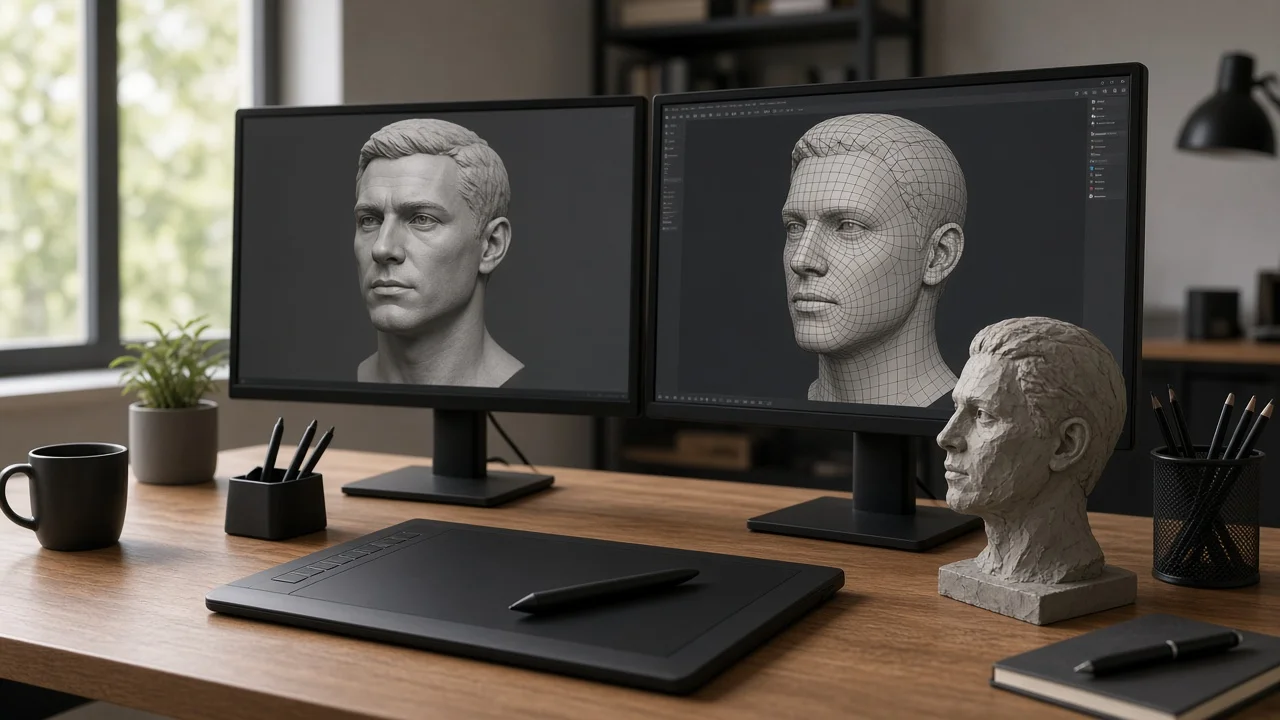
A finished sculpt is a performance, not a production mesh. It holds the silhouette, the pores, the folds, the damage. It also holds a polygon count that no real-time character can carry, and a topology that will collapse the first time a shoulder rotates. Retopology is the job of building the second mesh: the one the engine actually draws, skins, and ships.
This is not a cleanup pass. It is a design pass. You are deciding how the character deforms, how light wraps the forms, how LODs will collapse, and whether the bake from the sculpt will survive a close-up.
Why the sculpt is not the game mesh
Sculpting tools optimize for volume and surface detail. Dynamesh, voxel remesh, and dense subdivision put triangles wherever the brush needs them. That is correct for exploration. It is a liability for games.
A game mesh has to deform under a skeleton without collapsing volume in the joints, carry a UV layout that can hold a bake, sit inside a triangle budget, and stay editable when a director asks for a thicker neck. Those constraints pull in opposite directions. More loops around the mouth help phonemes and hurt the budget. Fewer poles keep the surface clean and make the shoulder harder to pose. Retopology is the negotiation.
If you skip it and decimate the sculpt, you get a mesh that looks fine in a still and fails in motion. Decimation preserves silhouette, not edge flow. Animation cares about flow.
What “game-ready” actually means
For a character, game-ready usually means a deforming mesh with predictable edge flow in the face, shoulders, hips, elbows, and knees; a triangle density that matches camera distance; UVs that can hold a bake without obvious seams on the face and hands; and normals that survive the engine’s tangent space.
It does not mean a 4K texture set on every asset. It does not mean quad-only dogma. Engines rasterize triangles. Quads are a modeling convenience; they should convert cleanly, without hidden ngons, and without a triangulation that splits a deforming joint the wrong way.
Edge flow that survives animation
Start from the joints, not from the nose. The places that bend define the loops you cannot skip.
On the body, you want loops that can compress and expand: holding edges around the elbow and knee, a clean deltoid wrap into the pectoral, and a hip loop that can sit and twist without shearing the pelvis into the thigh. The shoulder is the usual failure. If the clavicle, deltoid, and pectoral do not share a readable junction, every raise-arm pose will pinch.
On the face, think in rings: mouth, eyes, and a jaw loop that can drop without pulling the ear. The nasolabial fold is not a texture trick if the character talks in close-up; it needs a loop that can crease. Poles belong in the least animated real estate — temples, behind the jaw, the inner upper arm — not on the eyelid.
Clothing follows the same rule as skin. A jacket that is a shrink-wrap of the body will look cheap as soon as the elbow bends. Give cloth its own compression loops. If the garment is supposed to be rigid, keep those regions coarse and isolate them from deforming cloth with a clear topological seam.
Density, LODs, and triangulation
Pick a budget before you retopo. A third-person hero might live around 40–80k triangles including outfit and hair cards; a crowd NPC might be 8–15k. Spend density where the camera and the deformation meet: face, hands, and any cloth that reads at rest. Starve the back of the head under a helmet and the inside of a mouth if it never opens. Uniform density is a beginner tell.
Plan LODs as part of the same mesh. If hero LOD0 has eyelid loops and lip rolls, LOD1 should still have a mouth and eye that can blink. If you cannot describe that collapse in a sentence, the base mesh is too clever.
Quads, triangles, and the baker
Work in quads while you retopo so loops stay readable. Before bake and export, inspect the triangulation. A quad that looks fine in the viewport can triangulate across a joint and create a crease that no normal map will hide. Rotate those edges by hand on shoulders, fingers, and mouth corners. Collapse ngons before you UV.
UVs, cages, and the bake
If a loop exists to hold a fold, that fold probably wants a UV island break or a seam on the back of the form, not across the cheek. Keep texel density stable on the face and hands. Overlapping UVs are fine for mirrored armor; they are not fine for a face you will bake unique pores onto.
The cage is the quiet failure point. If it is a simple inflate of the low mesh, it will miss armpits, inner thighs, and the gap under a belt. Sculpt the cage until every ray hits the intended high-res surface. Check the bake in the engine’s tangent space, not only in the DCC. Match handedness, the green channel, and whether the engine expects MikkTSpace.
A practical order of operations
A stable character retopo pass looks like this:
- Freeze the sculpt’s silhouette. If the jaw is still changing, you are early.
- Block the body in a low, even mesh with joints placed.
- Build face and hands as their own problems. They consume the budget.
- Wrap clothing as separate meshes with their own flow.
- UV, then bake, then look at the result in-engine on a turntable and in a few extreme poses.
- Only then add hair cards, extra gear, and LOD variants.
People reverse this. They UV a messy mesh, bake, then “fix topology” and wonder why the maps swim. The bake is a snapshot of the low mesh. Change the low mesh and you owe another bake.
Common failure modes
Decimate and hope. You keep the look and lose the joints. The first animation pass will send the character back.
Too many poles on the face. Five-stars on the eyelid or lip create shading pinches that look like dirt in the normal map.
One mesh for body and hard armor. The plate should not inherit the stomach’s compression loops.
Uniform 100k triangles. The extra budget went to the shin instead of the mouth.
Bake without an engine check. The DCC viewport is not the renderer that ships.
Retopo before the silhouette is locked. You will do it twice.
Retopology is slow when it is treated as a tracing exercise. It is fast when it is treated as the moment you decide how the character will move. The sculpt is the drawing. The game mesh is the rig that drawing has to live in.